I’m slowly starting to lose track of my cookbook collection. A real collector would probably laugh, but I’ve stopped being able to keep up with my nearly 100 titles. There are books I refer to very often, there are those I reach for only seasonally, like the ones with Indian cuisine. There are also those I completely forget about. That’s exactly what happened with Salma Hage’s book “The Middle Eastern Vegetarian Cookbook“. I was looking for a recipe for a simple eggplant dish and this book fell into my hands. As I was browsing through it, I started marking recipes worth trying, but I quickly realized it would be easier to mark the ones I wasn’t interested in.
First up was eggplant in tomatoes with rice. A very easy dish to prepare, light and suitable for eating cold. Perfect for lunch, dinner or a picnic. I used brown rice, but if someone prefers white rice, that works too. I suggest cooking the rice a few hours ahead, cooling it and putting it in the fridge until you prepare the dish.
I think this recipe is a good opportunity to write a few words about resistant starch and explain why it’s worth cooling rice after cooking and then reheating it.
I decided to bring up the topic of resistant starch because I’m incredibly surprised by the fact that dietitians, diabetologists and general practitioners very often don’t inform their patients about the latest research results or trends in treatment or diet-supported treatment, especially in the case of diet-related diseases. It literally makes my jaw drop when a patient leaves a dietitian’s office with a brochure sponsored by one of the largest junk food producers. They learn from it that they should eat yogurt, cheese spread, breakfast cereals… The patient returns after a few weeks for a follow-up visit, and maybe their cholesterol dropped a bit, or at least didn’t go up, because the pills started working. There’s a small problem though, their sugar went up. Nobody told the patient that the yogurt is just sugar on powdered milk, and the breakfast cereals maybe don’t have sugar, but they have glucose-fructose syrup instead. Plus wheat as a filler. I don’t want to generalize, there are probably specialists somewhere who keep up with their education and don’t need sponsors in the form of food corporations, but my blood boils when a patient with very bad results hears from a doctor: “What kind of life is it on a diet, just take a pill and you can eat whatever you want. At most we’ll increase the dose at your next visit”.
Resistant starch / RS, to put it simply, is a type of starch that is not absorbed in the small intestine, passes to the large intestine and is excellent food for the good bacteria that live there. As a result, it supports the processes of sealing the intestinal walls and soothes existing inflammation in them.
Where can we find resistant starch? It turns out that for example in potatoes, rice and pasta. But there’s one condition, these products must be cooked and then cooled. The process of cooking and then cooling causes a change in the structure of the starch in these products. So nothing simpler, we cook large portions of potatoes, rice or pasta, cool them and store them in the fridge. Such a supply not only makes it easier for us to prepare meals, but also increases their health properties.
Interestingly, reheating these products means that the rise in blood sugar levels after eating them is significantly smaller than after eating them directly after cooking. In the case of rice, the difference in blood sugar levels reaches up to 50%.
This is very important information for people who have problems with high blood sugar levels.
Other sources of resistant starch include grains, legumes, unripe bananas, cashew nuts, oat flakes (raw)
If anyone would like to deepen their knowledge on this topic, I recommend the research results conducted by Dr Denise Robertson from University of Surrey (here) and (here)
Source of information: “The clever guts diet. How to revolutionise your body from the inside out”, Dr Michael Mosley.
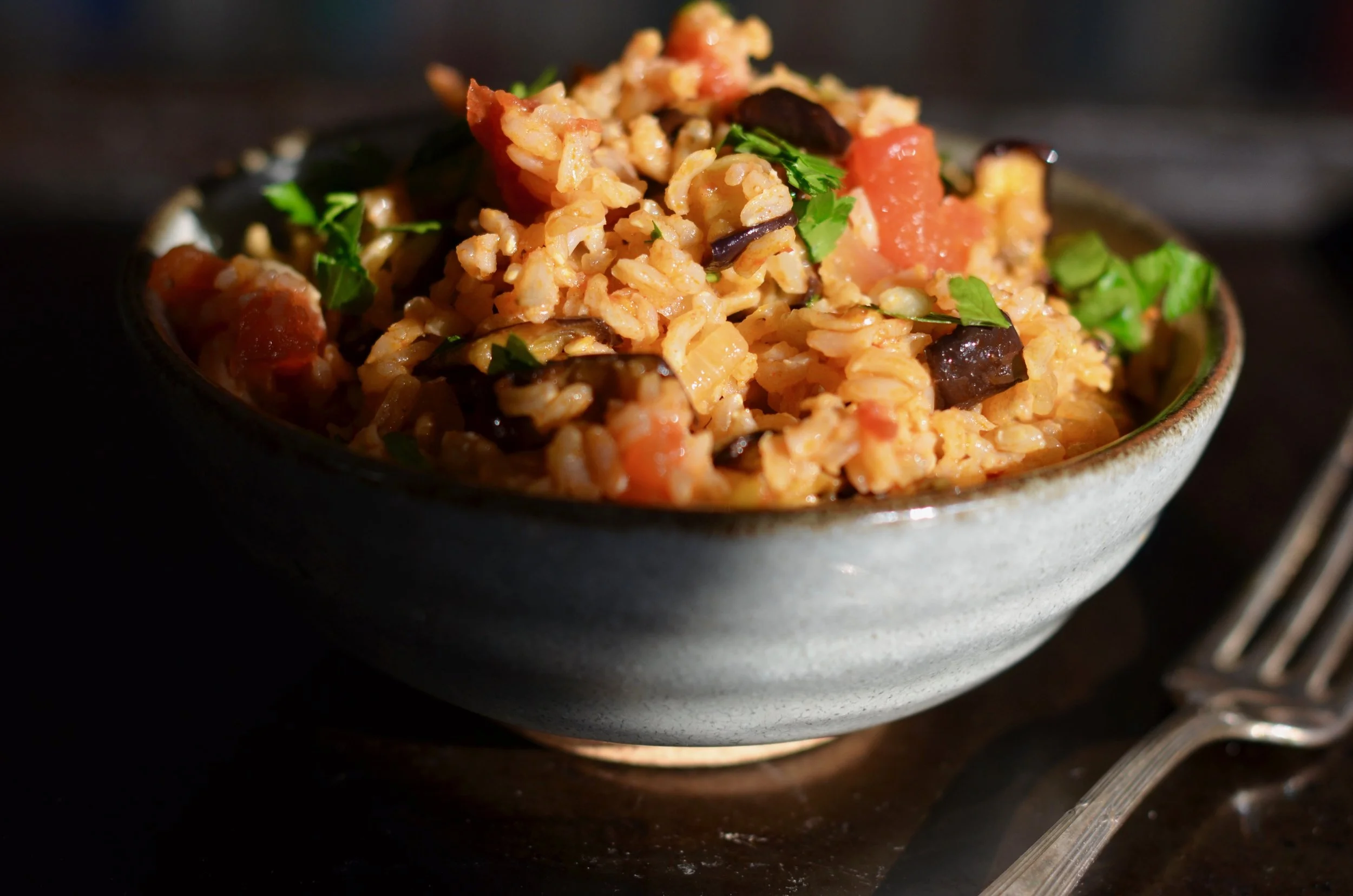
Baked Eggplant with Tomatoes and Rice
inspiration: “The Middle Eastern Vegetarian Cookbook”, Salma Hage
100 g long-grain rice, I used brown
1 large eggplant
1 onion, peeled and sliced
1 large garlic clove or 2 small ones, peeled and cut into very thin slices
5 tablespoons olive oil
2 tomatoes (total weight about 300 g), out of season we can use canned tomatoes
1 teaspoon ground cumin
1/2 teaspoon sweet paprika powder
salt, pepper
handful of chopped fresh parsley
Cook the rice until fluffy, cool and put in the fridge.
Preheat the oven to 190° C.
Cut the eggplant into cubes (1 cm x 2 cm), sprinkle lightly with salt and transfer to a strainer. After about 20 minutes, when the eggplant releases its juice, dry it on a paper towel, transfer to a bowl, drizzle with olive oil (3 tablespoons) and mix well. Transfer the eggplant to a flat baking sheet lined with parchment paper, place in the preheated oven and bake for about 25 minutes or until it softens and lightly browns. Set the baked eggplant aside.
Put the tomatoes in a container, pour boiling water over them and set aside for about 5 minutes.
Heat the olive oil (2 tablespoons) in a deep frying pan, add the sliced onion and sauté over very low heat. When the onion softens, add the sliced garlic, cumin and paprika, stir and sauté for another minute.
Remove the skin from the scalded tomatoes and cut them into cubes.
Add the tomatoes to the sautéed onion, bring to a boil and simmer over low heat for about 10 minutes, uncovered, the water from the tomatoes should evaporate slightly.
Season the sauce with salt and pepper. Add the baked eggplant, mix well, bring to a boil and finally add the rice. Mix everything thoroughly again and heat for 1-2 minutes.
Remove from heat and sprinkle with chopped fresh parsley.
Enjoy!


